Hello! Little Shiva here, with some orientation tips.
You can read the long, rambling, public description of life on the land here. If you’re on this page, it means you’re already on the tiny house team!
I’ll be working on condensing all this into a more easily-digestible format, but for now, I hope you can manage with this.
Here’s a video on how to change an empty gas tank.
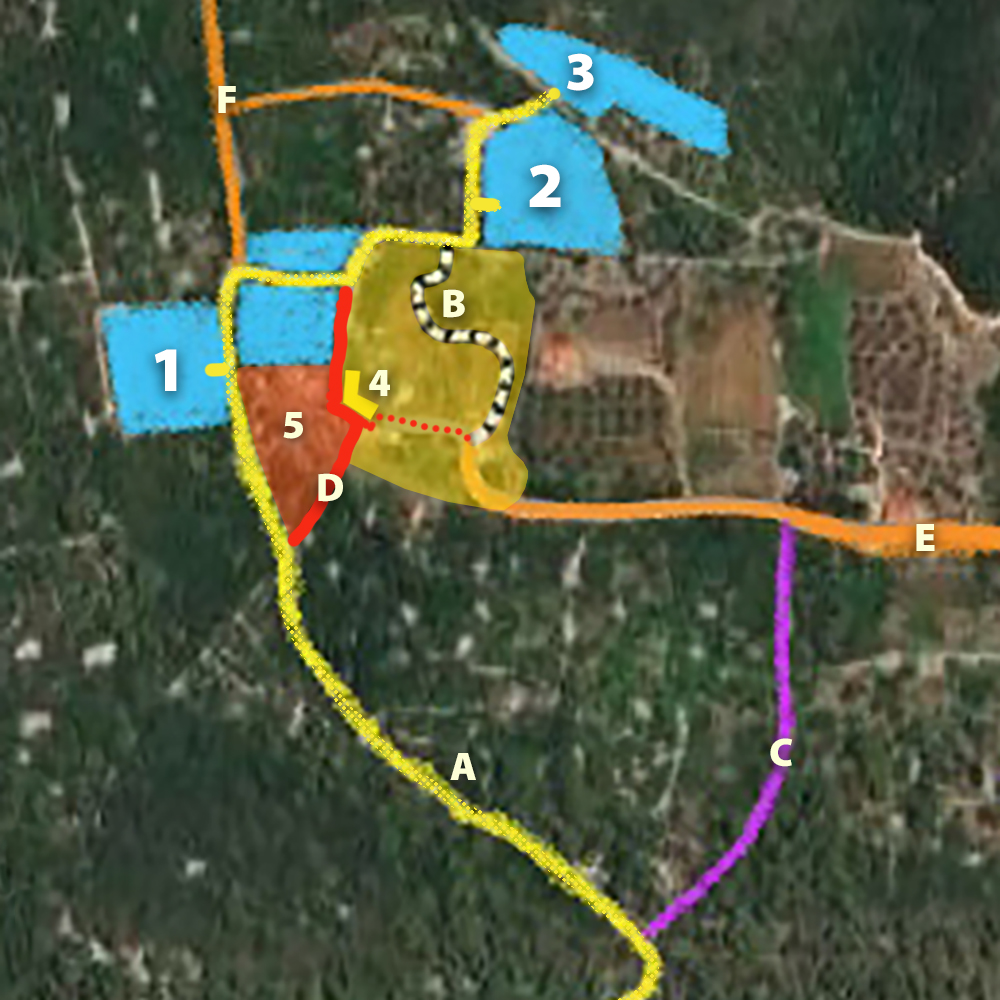
My land (in blue) consists of three main spaces, plus a buffer zone.
1. The Sky Garden (a.k.a. Cat Camp)
2. The Earth Garden (the tiny house and surrounding land, including the tiny forest)
3. The Sea Garden (beautiful sea views)
The unlabeled blue zone that you walk through between Cat Camp and the tiny house is the buffer zone, just wild bush. Nice.
The yellow space (4) belongs to Filip and Milica, who have two teenagers (a boy, Bepo, who has Down’s Syndrome, and a girl, Roza.) They live there most of the time, and have a small, thin windmill attached to their house. If you see any of them, be sure to say hello and introduce yourself. We keep a friendly distance.
The short red path (D) on the close-up map is public, but the neighbors don’t like us using it because they don’t like people walking behind their house. The little dotted extension I drew from the red public path (D) to the orange public road (E) is how you could walk around the side of their house, across their driveway and on to the road. But the dotted line goes through private property, so avoid doing this. We use avoidance instead of fences to respect one another’s privacy.
The one exception to this rule is when exchanging gas tanks. These are heavy and awkward to carry, so the neighbors said we can use the red path for that. Follow it all the way around the back of their house, then down the low, broad steps to the terrace on the side of their house. Somewhere near the shady back of the closest terrace is where the neighbor puts tanks he’s had refilled, and where you’ll leave your empties. Always check that a tank is full before carrying it back to the tiny house. Aside from the difference in weight, a full tank will have its cap (which covers the opening where you attach the hose) wrapped in plastic.
The black and white path (B) is the neighbor-approved way of getting from the road (E) to the tiny house and vice-versa, across the far end of the field in front of their house. There’s no sidewalk or anything, but you’ll figure it out, especially if you start from the tiny house, step down the old stone steps into the field below, and make your way towards the road. This is how cat food will be loaded in when a car comes up the road to deliver it.
The orange space (5) is another tiny house (not occupied full-time) that belongs to a DJ friend of the neighbors. Same rules apply for him as for neighbors: be friendly if you happen to see him, but avoid walking around his space.
The purple path (C) connects the road to the forest path, if for some reason that would ever be useful. I use it if I walk up the road but want to avoid the neighbors on my way to Cat Camp. I call it the longcut (as opposed to shortcut). I sowed some purple-flowering clover seeds all along that path: clover’s sprouting, can’t wait to see all the purple flowers!
The orange paths labeled F will eventually take you to the sea if you head in that direction, but further down, the path is very overgrown and you might get lost. Only go there if you have good bush skills, and with plenty of water. Clippers and a hand saw would be good too. The longer way to the sea (and safer, for now) is via the road (E). The shortcut to the sea is one of the paths I want to develop, for anyone who enjoys that sort of work. I love it!
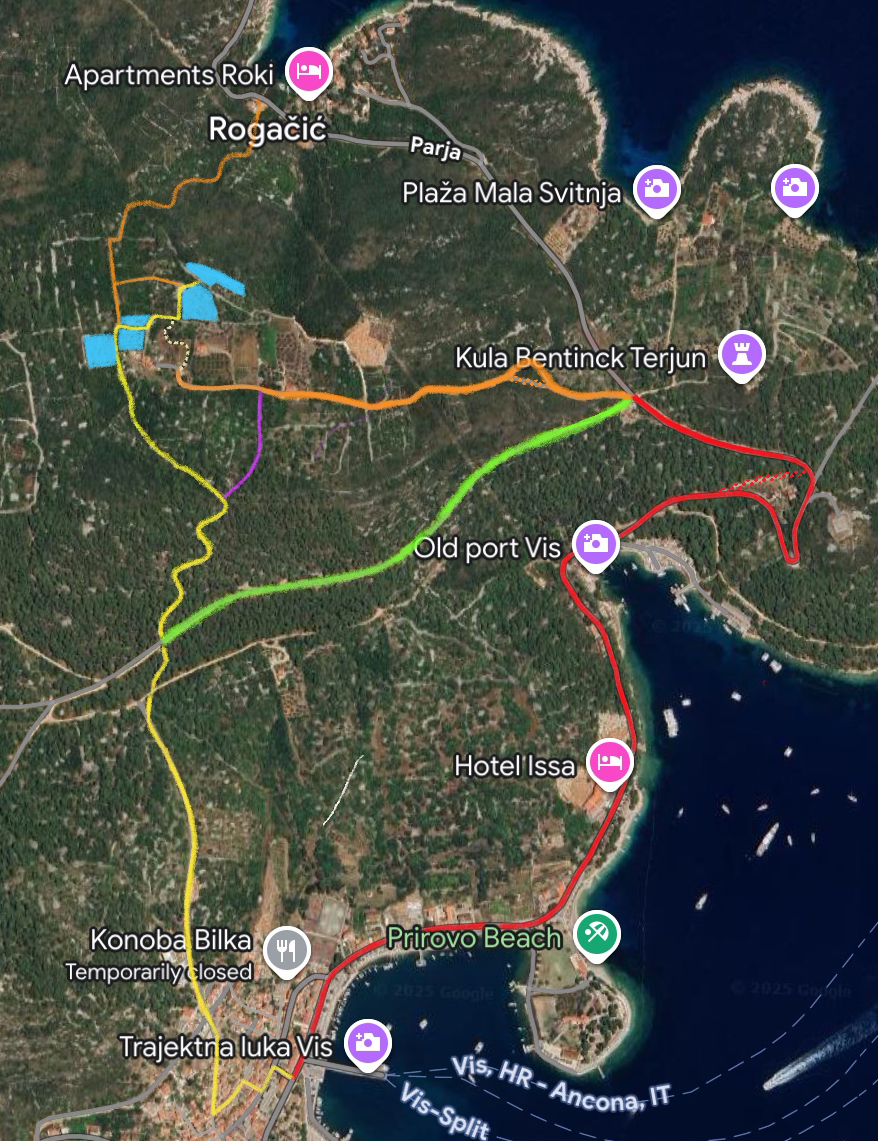
The yellow path (public, labeled A) is the path you’ll take through the forest. F is the direct continuation of A, but I used yellow to highlight the path you’ll take to and from town, through the forest, to and from Cat Camp and the tiny house.
The map above is a close-up of the map below, which gives you the entire route starting from the ferry. The long red path on the full map is the asphalt road leading from town to the base of our hill. The orange road that continues up is made of dirt and rock.
See what it’s like to walk the entire yellow path here. This video was shot in late summer, 2025, before a lot of path maintenance was done, so it was pretty bushy then. Clipping this back every so often is one of the land maintenance tasks that might need to be done during your stay.
Starting in 2026, June will be the month for work actions, where I’ll have more people staying on the land. I envision small teams of four to six people, tent camping, and whoever the team leader is can sleep in the tiny house, sharing the outdoor kitchen with the rest of the team. This will be to make sure that crucial tasks like path maintenance actually get done at least once a year. Leaving it up to people’s goodwill hasn’t been working.
This year (2026), we have some debris that needs to be removed: all sorts of bits and pieces leftover from many years of evolution of the infrastructure. The first half of June will be about carrying that to the road at the entrance to my neighbors’ land for pickup. The second half of June will be path maintenance. People can stay for either half of the month, or both – or longer, if this is something everyone is ok with!
Eventually, there will be more small shelters here and there on the land, but for now, the only proper shelter is the tiny house, so in winter we can only accommodate two people at a time. Once the weather gets nice enough for tent camping or, in the future, camping in a small shelter, we can accommodate a few more people for a bit longer during the year – all except winter. Think bed plus a bit of space to move around, probably smaller than the tiny house because building there is illegal. But we can do things that could be transformed if we got any complaints. And stay hidden, to avoid complaints in the first place.
To give you an idea of timing, it takes me at least 45 minutes to go from the ferry to Cat Camp, because I’m very slow. Some people have told me they can make it all the way to the tiny house in 30 minutes – wow!



This is Helper Cat. She'll show up in places where we need help, or where people are helping us. For example, the people behind this instagram account help us with fostering and adoption in Germany.